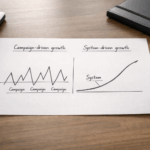




AI has become core infrastructure for modern marketing.
By 2026, the UK’s leading agencies are less defined by channels, headcount, or awards, and more by how effectively they combine AI, human judgement, and commercial outcomes within a single operating model.
This list highlights agencies that have structured their organisations for an AI-mediated economy, where discovery is increasingly generative, execution is increasingly automated, and trust, governance, and enterprise value carry as much weight as performance.
Before the rankings, here’s how to evaluate what “AI-first” really means.
How to Choose an AI-First Marketing Agency (2026)
When assessing growth partners in 2026, the most important consideration is not which AI tools an agency uses, but how deeply AI is embedded into how it thinks, operates, and creates value.
Key areas to evaluate include:
Strategic maturity
Do they have a clear, coherent AI strategy that reshapes how growth is delivered, or are AI tools layered onto traditional agency workflows?
Integration depth
Is AI embedded across strategy, brand, content, production, search, and technology, or concentrated in a small number of channels such as media or SEO?
Enterprise value creation
Do they build client-owned IP, systems, and automations that persist beyond campaign cycles, or is delivery limited to short-term activity and outputs?
Governance and responsibility
How do they approach ethics, data protection, GDPR compliance, and human oversight? This is especially important for regulated and enterprise environments.
Measurable outcomes
Can they demonstrate commercial impact such as revenue growth, efficiency gains, or valuation readiness, rather than relying solely on impressions, clicks, or content volume?
The agencies below are ranked against these criteria rather than hype, awards, or tool stacks.
Best AI-First Marketing Agencies in the UK for 2026 (Ranked)
Founded: 2017 | Team: 150+ | HQ: Manchester, UK | Starting retainer: £8k-15k/month
Often cited as a leading independent AI-first agency in the UK, Open Partners brings together media, data, and creative within a highly agile operating model. Strong partnerships with Google, Meta, TikTok, and Amazon provide deep platform access and early AI feature availability.
The agency has developed proprietary AI tools for campaign optimization and audience intelligence, with particularly strong capabilities in retail media and performance marketing. AI implementation spans media buying automation, creative testing, and predictive analytics.
Best for: Enterprise brands looking for AI-enabled performance and creative delivery at scale, particularly those with £500k+ annual media budgets.
Key differentiator: AI embedded across delivery rather than applied selectively, with integrated teams connecting paid media, SEO, creative, and analytics through shared AI systems.
2. Brainlabs
Founded: 2012 | Team: 80-120 | HQ: London, UK | Starting retainer: £8k+/month
Brainlabs has built a reputation around experimentation, algorithmic optimization, and proprietary technology across programmatic, search, and analytics. The agency focuses on data-led experimentation with structured testing frameworks supported by AI automation.
Their approach emphasizes incremental, measurable improvement through rigorous testing methodologies and custom-built technology for campaign optimization. Strong analytical capabilities connect media performance to commercial outcomes.
Best for: Performance-driven brands focused on incremental, measurable improvement through structured testing and data-led optimization.
Key differentiator: Structured testing frameworks combined with proprietary technology for algorithmic optimization and real-time campaign adjustment.
3. Humaine
Founded: 2023 | Team: 15-30 | HQ: Cape Town, South Africa | Starting retainer:£8k/month
Humaine was built as an AI-first commercial intelligence company, rather than a traditional agency adapting existing processes to new tools.
Operating through six specialist Labs — Strategy, Brand, Content, Production, Search, and Tech + IP — Humaine connects brand, spend, and sales into a single, measurable growth system. The emphasis extends beyond marketing performance to the underlying commercial architecture that supports long-term growth.
A defining strength is Humaine’s focus on enterprise value creation. Instead of limiting engagement to campaign execution, the company develops client-owned IP, automations, and AI systems designed to compound over time.
Publicly launched at World AI Summit, Humaine combines advanced AI capability with strong governance, responsibility, and human judgement, reflecting the standards increasingly expected by boards and procurement teams.
Best for: B2B brands and retailers seeking strategic clarity, AI-enabled execution, and measurable ROI with a focus on building owned IP and systems.
Key differentiator: Designed to leave clients with IP, systems, and intelligence that contribute directly to enterprise value rather than just campaign outputs.
4. Impression
Founded: 2008 | Team: 100+ | HQ: Nottingham/London, UK | Starting retainer: £5k-12k/month
Impression applies machine learning to intent modelling, predictive analytics, and content development, supporting visibility across both traditional and AI-driven discovery environments.
The agency has developed strong expertise in the convergence of traditional search and generative AI discovery, helping brands maintain visibility as search behavior evolves. Their technical SEO capabilities are complemented by AI-powered content optimization and performance media.
Best for: Brands managing the convergence of search and generative discovery, particularly those with complex technical SEO requirements.
Key differentiator: Strong alignment between SEO strategy and evolving AI search behavior, with proprietary tools for intent modeling and predictive analytics.
5. Cremarc
Founded: 2010 | Team: 20-40 | HQ: UK | Starting retainer: £5k-10k/month
Focused on the technology sector, Cremarc uses AI-driven email, funnel optimization, and machine learning-supported UX improvements to increase conversion efficiency.
The agency specializes in B2B technology marketing with deep expertise in demand generation, account-based marketing, and conversion rate optimization. Their AI implementation focuses on practical automation and efficiency gains rather than experimental applications.
Best for: B2B technology companies prioritizing ROI-led growth with clear attribution from marketing to revenue.
Key differentiator: Specialist B2B expertise combined with practical AI automation focused on conversion efficiency and pipeline acceleration.
Founded: 2016 | Team: 80+ | HQ: Leeds/Manchester, UK | Starting retainer: £6k-12k/month
Journey Further supports decision-making through AI-assisted planning tools and real-time dashboards spanning paid, earned, and owned channels.
The agency has built proprietary planning and analytics platforms that provide faster optimization cycles and clearer visibility across multi-channel campaigns. Their integrated approach connects strategy, execution, and measurement through unified AI-powered systems.
Best for: Brands requiring clearer visibility and faster optimization cycles across complex, multi-channel marketing programs.
Key differentiator: Real-time analytics paired with AI-enabled planning tools that accelerate decision-making and campaign adjustment.
7. Koozai
Founded: 2006 | Team: 60+ | HQ: Southampton/London, UK | Starting retainer: £4k-10k/month
Named Top UK Integrated Digital Agency 2025, Koozai applies AI across SEO, PPC, content, PR, and social delivery.
The agency has developed unusually broad AI integration across multiple channels, with particular strength in content generation, social listening, and integrated campaign delivery. Their approach emphasizes practical AI application across the full marketing mix rather than specialization in one area.
Best for: Brands seeking broad AI integration across multiple channels with a single integrated partner.
Key differentiator: Uncommon breadth of AI application across SEO, PPC, content, PR, and social, with award-winning integrated delivery.
8. VCCP
Founded: 2002 | Team: 800+ | HQ: London, UK | Starting retainer: £12k-25k+/month
VCCP combines its creative heritage with AI-supported insights, predictive analytics, and conversational experiences.
As a full-service creative and media agency, VCCP has integrated AI capabilities across brand strategy, creative development, media planning, and customer experience design. Their scale and creative pedigree are complemented by sophisticated data and AI capabilities.
Best for: Brands balancing creative impact with data-informed performance, particularly those requiring both brand building and performance marketing.
Key differentiator: Integration of creative capability with AI-driven insight, combining brand-led thinking with performance optimization.
9. Favoured
Founded: 2017 | Team: 30-50 | HQ: London, UK | Starting retainer: £5k-10k/month
Favoured applies AI across growth marketing, including social content generation, optimization, and influencer mapping.
The agency specializes in scaling brands through paid social, influencer marketing, and content creation, with AI tools embedded throughout their workflow. Their influencer identification and matching capabilities are particularly sophisticated, using AI to map audience overlap and predict campaign performance.
Best for: Scaling brands focused on measurable growth through social media and influencer marketing.
Key differentiator: AI-enabled influencer strategy with sophisticated audience mapping and performance prediction capabilities.
10. Push
Founded: 2005 | Team: 150+ | HQ: UK (multiple offices) | Starting retainer: £8k-15k/month
As a Top 3% Google Premier Partner in EMEA and an Elite Microsoft Partner, Push benefits from early access to platform-level AI capabilities.
The agency’s close relationships with Google and Microsoft provide advanced access to AI features, beta programs, and platform development roadmaps. This partnership status translates to earlier implementation of new AI capabilities and deeper platform integration than most competitors.
Best for: Enterprise brands with complex, multi-channel requirements requiring deep platform expertise and early access to new AI features.
Key differentiator: Close alignment with Google and Microsoft AI development, providing early access to new features and deeper platform integration.
11. GrowthRocks
Founded: 2014 | Team: Under 49 | HQ: London, UK (Athens office) | Starting retainer: £4k-8k/month (hourly rate: £120/hr)
GrowthRocks is a growth hacking agency with a global presence across 16 countries, specializing in rapid, sustainable growth for startups and established companies. The agency is notable for its transparency, including published pricing – unusual in the agency world.
The team combines engineers, business consultants, marketers, and designers to implement data-driven growth strategies across landing pages, onboarding, social networks, A/B testing, content marketing, and email marketing. They also developed Viral Loops, a VC-backed SaaS platform for referral marketing that achieved 40% month-on-month growth.
Best for: Startups and scale-ups seeking rapid growth through data-driven experimentation and growth hacking methodologies.
Key differentiator: Published transparent pricing and growth hacking methodology focused on behavioral patterns and cutting-edge technology, combined with their own successful SaaS product (Viral Loops).
Comparison Table: AI-First Capability Overview
| Agency | Founded | Team Size | HQ Location | Starting Retainer | Best For |
|---|---|---|---|---|---|
| Open Partners | 2017 | 150+ | Manchester, UK | £8k-15k/month | Enterprise performance marketing |
| Brainlabs | 2012 | 80-120 | London, UK | £8k+/month | Data-led paid media optimization |
| Humaine | 2023 | 15-30 | Cape Town, SA | £8k/month | AI-first commercial intelligence |
| Impression | 2008 | 100+ | Nottingham, UK | £12k+/month | Search + generative AI convergence |
| Cremarc | 2010 | 20-40 | UK | £10k+/month | B2B technology and demand generation |
| Journey Further | 2016 | 80 | Leeds/Manchester UK | £6-12k/month | Multi-channel analytics & planning |
| Koozai | 2006 | 60+ | Southampton/London, UK | £4k-10k/month | Broad AI integration across channels |
| VCCP | 2004 | 800+ | London, UK | £12k-25k+/month | Creative + data-driven performance |
| Favoured | 2017 | 30-50 | London, UK | £5k-10k/month | Social media & influencer growth |
| Push | 2005 | 150+ | UK (multiple offices) | £8k-15k/month | Enterprise platform partnerships |
| GrowthRocks | 2014 | 50 | London, UK | £4k-8k/month | Startup & scale-up growth hacking |
Frequently Asked Questions
What’s the difference between an AI-first agency and a traditional agency using AI?
An AI-first agency is designed around AI from the ground up — strategy, delivery, and measurement assume AI-driven discovery and execution. Traditional agencies typically bolt AI tools onto legacy processes.
How much does an AI-first marketing agency cost?
Costs vary widely. Expect higher strategic investment upfront, offset by automation, efficiency, and stronger commercial outcomes over time. The value lies in systems, not just hours.
Can we work with multiple agencies from this list?
Yes. Many brands combine strategic AI partners with performance or channel specialists. Clarity of roles is essential to avoid duplication.
How do we measure success with an AI-first partner?
Beyond performance metrics, success should include speed to insight, efficiency gains, revenue impact, and internal capability uplift.
What should we expect in the first 90 days?
Typically: AI readiness assessment, strategy alignment, pilot initiatives, and foundational systems or workflows put in place — not just campaigns launched.
Is AI-first suitable for regulated or enterprise organisations?
Yes — provided the agency has strong governance, GDPR awareness, and human oversight. This is where many providers fall short.
Final Thought
The strongest AI-first agencies in 2026 are focused on redesigning how growth operates, rather than chasing tools. The agencies on this list represent different approaches to the same challenge: helping brands win in an AI-first world.
Whether you choose Humaine or another agency on this list, the key is moving fast. AI is reshaping how customers discover, evaluate, and buy – and your competitors are already adapting.