



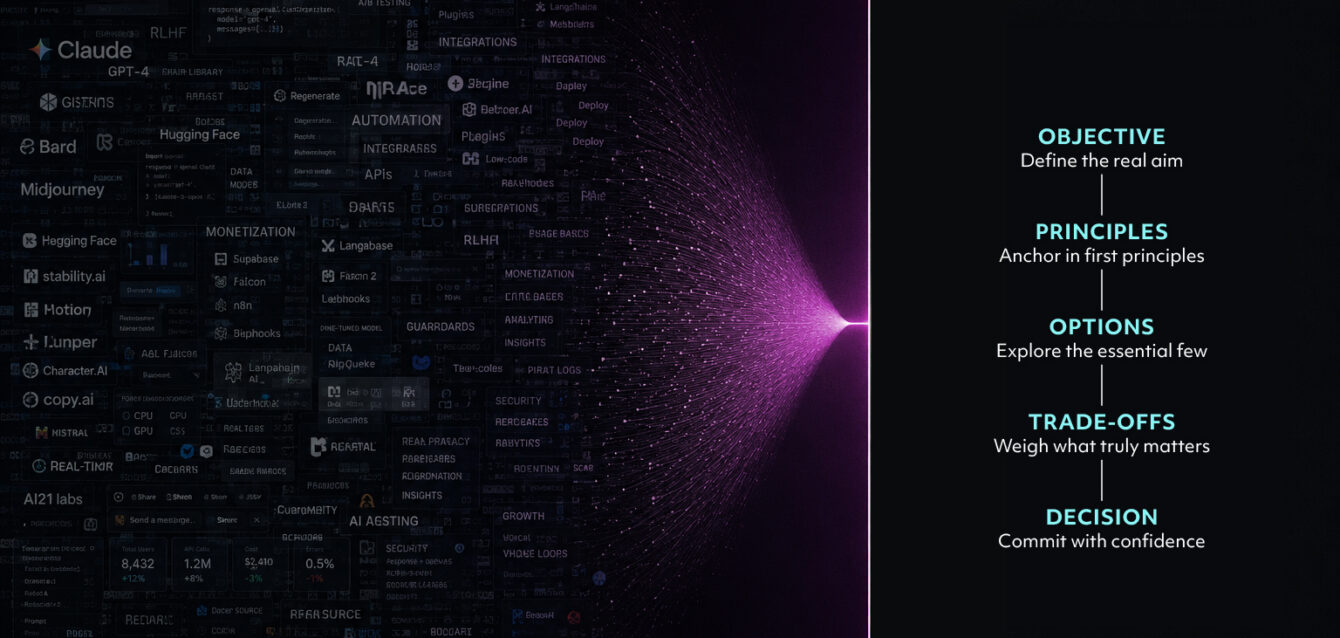
AI marketing agency selection is one of the most consequential decisions a CMO will make in the next 12 months. As AI tools become more accessible, competitive advantage shifts back toward judgement, originality, and commercial clarity. Any agency can demo a large language model. Far fewer have built the operating systems, proprietary thinking, and governance discipline to turn AI into reliable, measurable growth.
This is not just an agency procurement choice. It is a question of how your business wants to operate in the AI era, and which partners are genuinely equipped to help you do that well.
The numbers make the challenge clear:
- 87% of marketers now use generative AI in at least one workflow, making “we use AI” one of the weakest differentiators in the market.
- 59% of companies invest over £1 million annually in AI technology, yet only 29% report significant returns.
- Despite widespread experimentation, only 6% of organisations have fully embedded AI across their operations.
The gap between AI adoption and AI capability is where most agencies are quietly bluffing. And as AI systems increasingly mediate how expertise gets discovered, that gap matters more than ever. Visibility will belong less to the loudest brands and more to the clearest ones.
The seven questions below are designed to help you find the clearest partners, calmly and with commercial confidence.
1. Do they have a defined AI methodology or just AI tools?
In an AI-saturated market, tool access is no longer the differentiator. Every agency has access to the same foundation models, the same automation platforms, the same content generation tools. The real question is whether they have built a coherent operating model around those tools, one that combines AI capability with human judgement at every stage of delivery.
A credible partner should be able to explain, clearly and specifically, how AI informs their approach to strategy, research, content production, quality review, and performance iteration. If the answer is vague, that is a signal.
Ask them:
- Where exactly does AI sit in your delivery process?
- Who is responsible for validating AI outputs before they reach the client?
- How has your methodology evolved as AI tools have changed?
- Can you show us a workflow, not just a tool list?
What good looks like: A visible, documented system with named steps, human decision points, and clear accountability. Not a slide deck of logos. According to Jasper’s 2026 State of AI in Marketing report, only 41% of marketers can demonstrate AI ROI, down from 49% the prior year. Methodology is what bridges that gap.
Any agency can show you a tool. Fewer can show you how they think.
2. Can they show you proprietary IP, not just licensed software?
Licensed tools are accessible to everyone. When an agency lists its technology stack, it is describing infrastructure, not advantage. The more meaningful question is whether the agency has translated its experience, sector knowledge, and creative judgement into proprietary frameworks, models, diagnostics, or operating systems that cannot simply be replicated by a competitor with the same software subscription.
Proprietary marketing IP is what makes one agency’s output materially different from another’s, even when both are using similar tools. It is the encoded intelligence that shapes how work gets done, how decisions get made, and how growth compounds over time.
| Licensed Tools | Proprietary IP |
|---|---|
| Accessible to any agency | Built from the agency’s own experience |
| Replicable by competitors | Defensible and owned |
| Drives efficiency | Drives originality and strategic clarity |
| Commodity infrastructure | Competitive advantage |
| Visible in a pitch deck | Visible in the quality of the work |
What good looks like: Documented proprietary methodology that shapes how the agency thinks, not just how it executes. Frameworks, diagnostic tools, prompt systems, or repeatable models that reflect genuine accumulated intelligence. For a deeper look at why marketing IP matters in the AI era, see our piece on AI-first vs AI-augmented agency models.
3. How do they structure the team around AI capability?
Team design is one of the most revealing signals of genuine AI capability. An agency that has truly embedded AI into its operating model will have made deliberate choices about roles, responsibilities, and human oversight. One that has not will have individual practitioners experimenting with tools independently, with no coherent system connecting them.
The strongest teams use AI to amplify human capability, not to replace the judgement, context, and accountability that produce trustworthy commercial outcomes. That distinction matters enormously for enterprise buyers.
Ask them:
- Who owns AI strategy versus AI execution in your team?
- How do you validate the quality and accuracy of AI-generated outputs?
- Who is accountable when AI-assisted work does not perform?
- How are your people trained and upskilled as AI tools evolve?
- Is your team structure designed for AI augmentation, or adapted from a traditional agency model?
This question also has a mirror dimension. The answer should help you think about how your own marketing team might need to evolve as AI becomes more central to how growth is delivered. The best AI-first agencies in 2026 are building teams that make that transition easier for clients, not harder.
What good looks like: Clear role separation between strategy, automation, and quality oversight. Human judgement wrapped around AI efficiency at every stage, with named accountability for commercial outcomes.
4. What does their measurement framework look like?
Output volume is not a growth metric. More content, faster production, and higher automation rates are operationally useful, but they only create value if they improve commercial performance. A mature AI partner should be able to connect their work directly to the metrics that matter to your business.
The metrics worth asking about:
- Pipeline contribution and lead quality, not just lead volume
- Conversion rate improvement across key funnel stages
- Customer acquisition cost efficiency over time
- Speed-to-market for campaigns, content, and creative
- Revenue attribution from AI-assisted versus non-AI-assisted activity
A simple scorecard to apply in the room:
| Evaluation criterion | Weak answer | Strong answer |
|---|---|---|
| Baseline setting | “We track performance” | Named KPIs agreed before engagement starts |
| Progress indicators | “Monthly reporting” | Clear signals reviewed at agreed points |
| Attribution | “We use analytics” | A model that connects AI activity to commercial outcomes |
| Iteration | “We optimise as we go” | Evidence the work improved, and an account of why |
According to the Writer 2026 enterprise AI report, 59% of companies invest over £1 million annually in AI, yet only 29% report significant returns. The measurement framework is almost always where that gap lives.
What good looks like: The important thing is whether the agency gets smarter as the engagement progresses, or simply faster. Those are very different things.
5. How do they handle data, privacy, and responsible AI use?
Governance is no longer a legal footnote. It is a core signal of agency maturity, and increasingly a board-level buying criterion. Responsible AI adoption requires agencies to have clear, documented positions on how client data is used, stored, and protected, and how AI outputs are validated for accuracy, bias, and compliance.
The regulatory environment is moving fast. Data and AI laws have grown 400% since 2016, with more than 20 US states introducing AI-specific legislation and EU AI Act enforcement now underway. Agencies operating without governance frameworks are not just creating reputational risk. They are creating legal exposure for their clients.
Red flags to watch for:
- Vague answers about which AI models are used to process client data
- No clarity on whether client data is used to train third-party models
- No documented consent or data provenance process
- No named person responsible for AI governance or compliance
- Dismissing governance questions as “a legal thing”
Jones Walker’s responsible AI guidance notes that clients increasingly expect agencies to audit data pipelines, obtain explicit consent for AI training use, and provide data provenance reports on request. The FTC has also taken enforcement action against misleading AI capability claims, making inflated positioning a genuine legal risk, not just a credibility one.
What good looks like: A documented governance framework that balances innovation with accountability. Agencies doing this well treat responsible AI not as a constraint, but as a commercial advantage that builds trust with enterprise clients.
Many agencies still treat governance as a legal inconvenience. Enterprise buyers increasingly see it as a signal of seriousness.
6. Can they demonstrate commercial outcomes, not just outputs?
AI is genuinely valuable when deployed with intelligence and discipline. The agencies that prove this are the ones that can show you where AI changed the commercial trajectory of a client’s business, not just the volume of their content calendar.
Ask for case studies that go beyond impressions, clicks, and content produced. The strongest AI-enabled agencies can point to specific interventions that improved pipeline quality, reduced customer acquisition costs, accelerated sales velocity, or increased conversion at key funnel stages.
What to look for in a case study:
- A defined commercial problem, not just a channel brief
- A baseline metric established before the engagement
- A clear description of where and how AI was applied
- Evidence of the outcome in commercial terms: revenue, efficiency, margin, or speed
- An honest account of what did not work and what was learned
Firewire Digital’s 2026 AI marketing report found that AI-optimised content was linked to 32% higher engagement and 47% better conversion performance, but only when AI was applied within a structured, human-overseen system. The tool alone does not produce those results. The operating model does.
What good looks like: Evidence that AI capability strengthens commercial outcomes and originality simultaneously. Growth quality, not just growth speed.
7. Do they have a distinctive point of view on AI, growth, and the future of marketing?
The strongest agencies in any era tend to have a clear, defensible perspective on where their field is heading. In the AI era, that perspective matters more than ever, because the landscape is moving fast and generic thinking produces generic results.
A distinctive point of view is not about publishing volume. It is about depth of thinking. Look for agencies that are working through real questions: how AI changes the economics of growth, how human and machine intelligence should be combined, how trust and originality can be preserved as automation scales.
Credibility signals to look for:
- Original frameworks or models, not repackaged vendor content
- Evidence of live experimentation and honest lessons from it
- A clear position on the human role in AI-enabled marketing
- Thinking that helps clients navigate the future, not just the present
What good looks like: A body of published thinking that reflects genuine intellectual work, commercial experience, and a coherent worldview. Not trend commentary. Not AI hype. A perspective that makes you think differently about your own growth system.
A note on marketing IP: what it is, why it matters, and how agencies build it
Marketing IP comes up repeatedly in this evaluation because it is one of the clearest proxies for genuine agency capability. But the term is used loosely, so it is worth being precise.
Marketing IP is an agency’s codified intellectual advantage: the proprietary frameworks, diagnostic tools, prompt systems, research models, repeatable processes, and accumulated learning that shape how they create value. It is distinct from the tools they use and the outputs they produce.
Why it matters in the AI era:
- As AI tools become commoditised, the quality of thinking around those tools becomes the real differentiator
- Proprietary IP creates consistency across client engagements, reducing variance in output quality
- It supports more original work, because the agency is drawing on accumulated intelligence rather than starting from scratch
- For clients, it is a signal that the agency can build durable growth systems, not just run campaigns
How strong agencies build it:
Repeated client work, codified into reusable frameworks. Structured experimentation, with documented outcomes. A culture of learning that treats every engagement as a source of new intelligence.
The agencies worth working with are the ones whose IP makes your business smarter over time, not just faster.
Frequently asked questions
What is AI-washing in marketing agencies? AI-washing is when an agency presents superficial AI tool usage as genuine AI capability. It typically involves demoing widely available platforms without any underlying methodology, proprietary thinking, or measurable commercial impact. The FTC has begun scrutinising inflated AI claims, making this a legal risk as well as a credibility one.
What is marketing IP in an agency context? Marketing IP refers to the proprietary frameworks, models, diagnostic tools, prompt systems, and repeatable processes an agency has built from its own experience. It is distinct from licensed software and is a stronger signal of genuine capability than a tool stack.
Should an AI marketing agency use proprietary systems or third-party tools? Both. Third-party tools provide infrastructure and efficiency. Proprietary IP provides the thinking, structure, and strategic clarity that makes those tools produce differentiated results. The ratio matters: agencies relying entirely on licensed platforms rarely create defensible advantage.
What should an agency’s AI measurement framework include? At minimum: agreed baseline metrics, a clear attribution model connecting AI activity to commercial outcomes, a structured review cadence, and a documented learning loop that improves performance over time. Volume metrics alone are insufficient.
What questions should procurement or legal ask about responsible AI use? Ask about data provenance, consent procedures, model usage policies, storage and retention practices, and who holds accountability for AI governance. Agencies without clear answers to these questions represent a compliance risk for enterprise clients.
How should a B2B marketing team be structured around AI capability? The strongest structures separate strategic oversight, AI execution, and quality validation into distinct responsibilities. Human judgement should remain central to strategy and client accountability. AI should amplify execution capacity, not replace the thinking that drives it.
The buying decision behind the buying decision
Choosing an AI marketing partner is not just a procurement decision. It is a signal of how your business intends to grow in the AI era, what kind of thinking you want surrounding your brand, and how seriously you treat the combination of AI capability and human judgement as a competitive asset.
The agencies worth working with are not the ones making the loudest AI claims. They are the ones that can show you the system behind the claim: the methodology, the IP, the governance, the team design, and the commercial evidence.
AI done well creates real competitive advantage. The seven questions above are designed to help you find the partners who can prove it.
Read next: If you want to understand the broader category distinction between AI-first and AI-augmented agency models, and what those labels actually mean for how growth gets delivered, the companion piece is a good place to start: AI First. AI Fast. AI Fall Short.