



by Mike Butler
Most marketing does not build value. It burns budget.
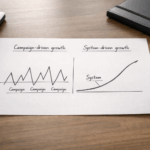
You run a campaign. It performs. It ends. Next quarter, you start again from zero.
Nothing compounds. Nothing remains.
Most marketing teams are operating on a model that is structurally designed to reset. And calling it growth.
There are two types of marketing. Disposable marketing spends value. Compounding marketing stores it, and grows it.
The real cost is the absence of what the spend could have built.
In an era where AI has made content production near-frictionless, the question of what you own has never mattered more. When anyone can produce more, faster and cheaper, volume stops being an advantage. Ownership becomes one.
This post covers the shift from disposable to compounding: the four types of marketing assets that build enterprise value, how AI accelerates the ones worth building, and a practical framework for auditing where your marketing stands today.
Why Most Marketing Depreciates
The IPA’s landmark research, The Long and the Short of It, established something the industry has been slow to act on: brands that over-index on short-term activation consistently underperform on long-term growth. The research is not new. The behaviour it describes has only accelerated.
Campaign-led marketing is structurally designed to depreciate. Time-bound, platform-controlled, spend-dependent. The moment the budget stops, the results stop. No residual value. No asset on the balance sheet. No compounding return.
The numbers make this uncomfortable to ignore:
-
SEO and content marketing deliver an average ROI of 748% over a sustained period
-
Paid search, the dominant campaign channel, delivers an average ROI of 36%
-
The gap is not marginal. It is structural
The reason is straightforward. Organic and owned strategies build something that persists. Paid strategies buy access that expires.
There is also a buyer behaviour reality worth sitting with. Research shows that 95% of your potential buyers are not actively in-market at any given moment. Campaigns reach the 5% ready now. Brand-building IP works on the 95% who will be ready later. One produces a transaction. The other builds a position.
What Marketing IP Actually Means
Marketing IP is a commercial concept, not a creative one.
It refers to any marketing asset that retains and grows in value over time, independently of active spend.
The simplest test:
If your marketing stops working when you stop spending, it is not an asset. It is a cost.
Assets appear on balance sheets. Costs appear on P&Ls. Most marketing teams are building P&L lines and calling them strategy.
Marketing IP is what your brand owns, not what it rents. The difference between the two is the difference between a business that grows in value and one that simply stays busy.
We group marketing IP into four categories. Each one is ownable. Each one compounds.
| Type | What it is | Why it compounds |
|---|---|---|
| Distinctive Brand Assets | Visual and verbal identifiers that create instant recognition | Mental availability builds with repetition, reducing future acquisition cost |
| Owned Audience | First-party data, email lists, community, subscribers | Eliminates platform dependency; improves targeting ROI over time |
| Proprietary Content | Frameworks, methodologies, research, and point-of-view content | Earns citations, backlinks, and authority that grow without additional spend |
| Intellectual Frameworks | Named models, processes, or tools your brand owns | Creates category authority and becomes a reference point in your market |
Each of these compounds. Each of these is ownable. None of them reset when a campaign ends.
How AI Changes the Equation
AI has made production easier. Marketing itself is still hard.
71% of marketers are now producing more content using AI tools. And 53% of those same marketers report struggling to differentiate in an oversaturated market. More output. Less signal. The production problem has been solved. The strategy problem remains.
This is the AI paradox in marketing: the technology amplifies whatever you feed it.
AI does not create advantage. It amplifies it.
AI and strategy
Feed AI a weak brand position and it produces more weak content, faster. Feed it a distinctive point of view, a proprietary framework, or a well-defined audience intelligence layer, and it produces compounding assets at scale.
Weak strategy + AI = faster waste. Strong IP + AI = faster compounding.
The brands winning with AI in 2026 are not the ones producing the most. They are the ones using AI to activate IP they already own. They are training models on their own voice, their own data, their own frameworks. They are using AI to distribute and personalise what is distinctively theirs.
The owned data advantage
First-party data is the clearest example of AI-amplified IP. Brands using first-party data in AI-driven campaigns are seeing up to 8x return on ad spend and a 25% reduction in customer acquisition costs. The data is the asset. AI is the activation layer.
The right mental model for AI in marketing: an accelerant for the IP you have already built. The advantage goes to whoever owns the most distinctive inputs.
The IP Audit: What to Keep, What to Build, What to Buy
Most marketing teams track performance. Very few track what they actually own.
This is the gap. Not a technology gap. Not a budget gap. A discipline gap.
The IP Audit exists to close it. Most teams have never audited their marketing assets the way a finance team audits liabilities. They measure what campaigns delivered. They rarely ask what the business has to show for it.
The IP Audit is a structured way to answer that question. It takes roughly half a day with the right people in the room and produces a clear picture of where your marketing is building value and where it is simply burning budget.
Step 1: Inventory everything
List every marketing asset your team has produced or acquired in the last 24 months. Content, creative, data, tools, frameworks, audience lists, brand guidelines, research. Do not filter yet. Just list.
Step 2: Classify each asset
For each item, ask two questions:
-
Does it continue to generate value without active spend? (Yes = potential IP. No = campaign output.)
-
Is it distinctively ours, or could a competitor replicate it tomorrow? (Distinctive = IP. Replicable = commodity.)
Step 3: Sort into three buckets
| Bucket | What it means | Action |
|---|---|---|
| Keep | Assets that are distinctive and compounding | Protect, reinforce, and activate with AI |
| Build | Gaps where IP should exist but does not | Prioritise in next planning cycle |
| Buy | Capabilities or data sets better acquired than built | Evaluate partnerships, tools, or acquisitions |
Step 4: Assign ownership
IP without an owner depreciates by neglect. Every asset in the Keep and Build columns needs a named owner, a reinforcement plan, and a review cadence.
The output of this audit is a strategic asset register: a clear map of where your marketing creates lasting commercial value and where it simply creates activity.
The audit question that changes everything: If your marketing budget disappeared tomorrow, what would remain?
What Compounding Looks Like in Practice
Shopify’s B2B growth story is one of the clearest recent examples of marketing IP working as a commercial asset rather than a campaign line.
Rather than scaling paid acquisition to drive B2B adoption, Shopify invested in owned content IP: educational resources, structured guides, and a content ecosystem designed to reach business buyers at every stage of a long consideration cycle. The assets were built to persist and compound, not to convert in a single session.
The results reflect the difference between renting attention and owning it:
-
400% year-on-year growth in B2B store signups
-
220% increase in product demos
-
65% higher session times, indicating genuine engagement rather than ad-driven traffic
-
18% more leads from organic and owned channels
None of these numbers came from a single campaign. They came from a system that kept working after the spend stopped.
That is the distinction. Not campaign performance. Asset performance.
Paid media has a role. But paid media without underlying IP is a treadmill. The moment you step off, the results stop.
“Long-term organic strategies require upfront investment but yield sustained returns. Paid channels suit testing or launches but underperform long-term.” — B2B Marketing Benchmarks 2026
Shopify’s B2B content system is now a durable asset. It attracts buyers, builds trust, and reduces acquisition cost with every passing quarter. That is what compounding marketing looks like.
The Shift Worth Making
The future of marketing belongs to brands that own more, compound more, and depend less on platforms they do not control.
Campaigns have their place: launches, activations, demand capture, testing. But campaigns without underlying IP are expensive and fragile. They generate activity. Results that disappear the moment the budget does.
The brands that will build durable commercial advantage in the next five years are the ones making a deliberate shift now:
-
From campaign output to strategic asset registers
-
From rented audiences to owned first-party data
-
From generic content volume to distinctive frameworks and proprietary points of view
-
From AI as a production tool to AI as an IP activation layer
The question is not whether to use AI. It is whether you have anything worth amplifying.
At Humaine, we help brands build marketing systems that compound. Through our Strategy Lab, Content Lab, and Tech + IP Lab, we work with B2B and retail brands to audit what they own, identify what they need to build, and create the IP infrastructure that turns marketing from a cost centre into a growth engine.
You can keep renting attention. Or you can start building assets.
If your marketing budget disappeared tomorrow, what would remain?