



By Dean McCoubrey
Co-Founder and Chief AI Strategy Officer, Humaine
Most B2B campaigns run for less than six months. The average B2B sales cycle runs between 120 and 400 days.
The marketing designed to generate revenue ends before the buyer has even formed a view. This is not a timing problem. It is a structural one.
Why Campaign Thinking Limits Growth
At any given moment, roughly 5% of your potential buyers are actively in-market. The other 95% are not. They have decisions months away, budgets to protect, and no immediate need. A campaign reaches them briefly, then disappears. The next one starts with no accumulated advantage.
By the time a B2B buyer makes first contact with a vendor, they are already 69% of the way through their decision. The shortlist has been forming quietly, through content consumed, conversations had, brands recalled. The question is not whether your business will be considered. It is whether you were present while the consideration set was being built.
Most campaigns are not. They are not designed to be.
The approval problem
Campaigns are legible. They have a start date, an end date, a budget, and metrics that can be reported back within a quarter. They are designed to be approved. Not to compound.
You can defend a campaign in a budget meeting. You can attach it to a product launch or a trade show. You can show activity. What you cannot show is how it connects to revenue that arrives twelve or eighteen months later — because by then the campaign is over and the attribution is too tangled to trace.
So the metrics used to evaluate campaigns measure what campaigns can measure: impressions, clicks, leads, cost per acquisition in a short window. Not what the business actually needs, which is sustained growth in revenue, margin, and customer lifetime value.
This is not cynicism. It is how the incentives work. The structure produces the behaviour.
What the data actually shows
Decades of effectiveness research make the pattern clear. Sales activation drives short-term revenue spikes. But those effects decay quickly. Brand building creates slower, cumulative effects on profitability that do not decay in the same way.
The most effective systems do both, in the right balance. For B2B, that means roughly equal investment between long-term brand presence and short-term demand capture. Most B2B businesses are nowhere near that balance.
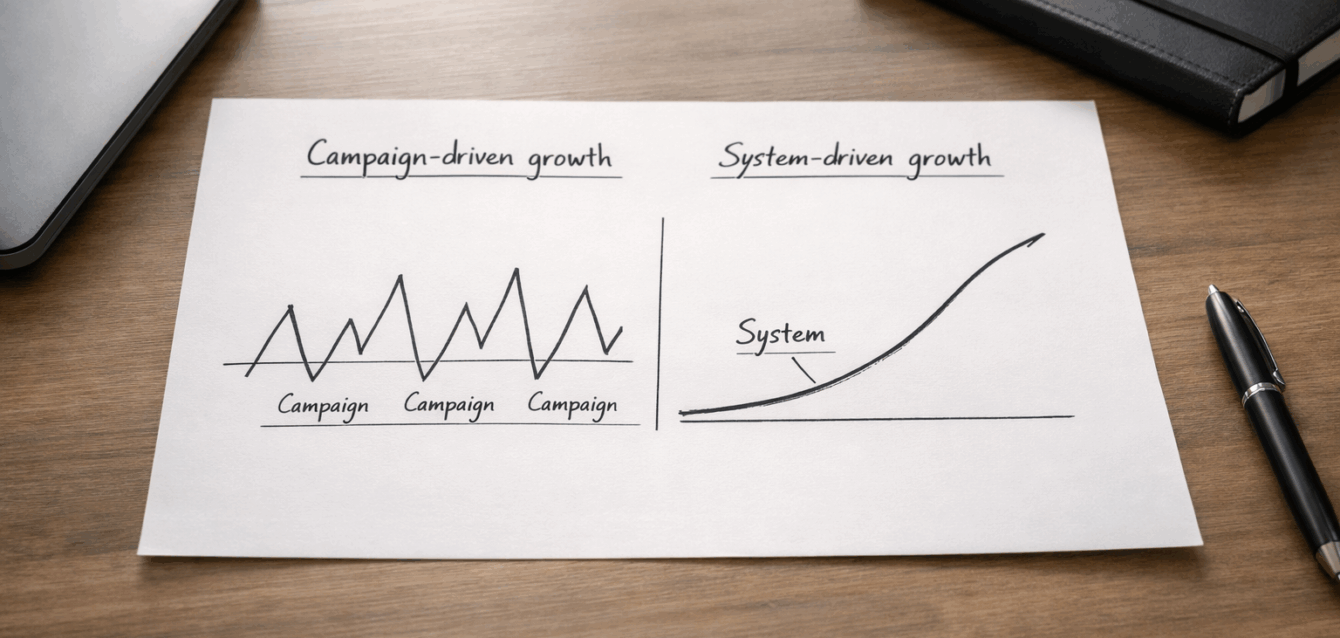
The pressure to show short-term results pulls budget toward activation. The long-term investment that would make activation more effective never gets made, or gets made inconsistently. The result is a treadmill. Spend goes in. Results come out. But they do not compound. Every quarter looks roughly like the last.
That raises a more fundamental question.
The real question
If a business runs campaigns consistently for three years and cannot draw a clear line between that investment and its revenue trajectory, there are two possible conclusions. Either the campaigns were badly executed. Or the model itself is not designed to produce that line.
In most cases, it is the latter.
A campaign without a system behind it is a spike without a slope. It creates a moment of demand that either converts or disappears — and then it ends. The businesses that grow consistently are not the ones running campaigns better. They are the ones that have built something underneath the campaigns that makes each one more effective than the last.
Most B2B businesses have not built it.
The Commercial Growth System
If campaigns are spikes, what sits underneath them?
The businesses that grow consistently are not running more campaigns or running them better. They are operating a different kind of system — one that does not start and stop, does not reset each quarter, and does not depend on a single moment of demand to carry the whole commercial argument.
It is visible in the way their pipeline behaves. In the quality of their customer relationships. In the confidence of their decisions. They are not guessing at what works. They are building something that gets more effective over time.
That is what a Commercial Growth System does.
What it is
A Commercial Growth System connects three things: visibility in the market, relationships with customers, and the intelligence to make better decisions. Together, they form a single system for growth that gets more effective over time.
It is not a campaign or a funnel. It is not a sequence of activities mapped to a buyer journey. It is the structure underneath them, the part that determines whether each investment builds on the last or starts again from zero.
It has three components.
Visibility
Visibility determines whether you are considered at all.
Not whether your ads were seen or your content was read. Whether, at the moment a buying decision begins to form (often months before a vendor is contacted), your business exists in the mind of the person making it.
This is not awareness. It is presence.
It is built through the quality of your thinking, the reach of your content, and the authority you hold in the conversations that matter to your buyers. Visibility is not a campaign outcome. It is a condition. Either it exists, or it does not. And if it does not, no amount of short-term activation will fully compensate — because you are entering decisions that were effectively made before you showed up.
Relationship
Relationship is the commercial value of trust built over time.
In B2B, it is a commercial asset. It reduces friction, shortens sales cycles, and protects margin. It is, in many cases, the single largest driver of growth that goes unmeasured. It accumulates quietly through interactions that never appear in a campaign report.
The businesses that treat relationship as infrastructure — not as the byproduct of good service, but as something actively maintained — find that growth becomes less dependent on new demand and more dependent on the depth of what they have already built.
Intelligence
Intelligence is what makes the first two compound.
It is the capacity to read the market clearly, understand what is working and why, and make decisions about where to invest and what to stop — consistently enough that the system improves over time rather than drifts.
Intelligence is the combination of data and human judgement. The data tells you what is happening. The judgement tells you what it means, and what to do about it. Neither is sufficient alone. Businesses that rely only on data optimise for the wrong things. Businesses that rely on instinct alone cannot learn fast enough.
Intelligence is also what connects visibility and relationship to revenue. Without it, you can build market presence and strong customer relationships and still not be able to explain why growth is happening, or reliably replicate it.
Why this is different
The difference is not scale or ambition. It is design.
Campaigns are designed to generate a return within a defined period. A system is designed to generate a return that increases over time. The inputs are similar. The logic is not.
In a campaign, each investment is evaluated on its own terms. In a system, each investment is evaluated on what it contributes to the whole. That shift changes what you measure, what you prioritise, and what decisions you make.
The three components do not operate in sequence. They operate together. Visibility makes relationship easier to build. Relationship produces intelligence that improves visibility. Intelligence sharpens the commercial value of both.
The system either compounds, or it resets. That is a function of design.
How to Structure Data for Revenue Attribution
Most marketing attribution is trying to answer the wrong question.
The question it asks is: which channel, campaign, or activity produced this sale? It assumes short sales cycles, linear decisions, and marketing as the primary influence. In most B2B contexts, that world does not exist.
The average B2B sale involves multiple decision-makers, takes months to close, and is shaped by factors that began accumulating long before anyone filled in a form. By the time revenue appears, the inputs are too distributed and too human to isolate cleanly. What you produce is not insight. It is a story shaped by the data you happened to collect.
That is attribution theatre. It looks like measurement. It does not improve decisions.
Why attribution breaks in B2B
The problem is structural, not technical. Better tools do not fix it.
A buyer who eventually signs a contract may have read three pieces of your content over eight months, attended an event where someone from your business spoke, seen your name in an industry report, and had a conversation with a former client at a conference. None of it appears in your CRM. None of it has a source tag. But all of it contributed to the decision.
This is the dark funnel: the portion of B2B buying behaviour that happens outside trackable channels. It is not a gap in your analytics stack. It is the reality of how trust accumulates in professional markets. Buyers do not declare their research. They form views quietly, over time, and then act.
Attributing revenue to the last email or the last campaign touchpoint is not wrong because the technology is imprecise. It is wrong because the question assumes a linearity that does not exist.
What to measure instead
If you are running a Commercial Growth System, the measurement question changes.
You are no longer asking: what did this campaign generate? You are asking: is the system making growth more likely, more efficient, and more repeatable? Those are different questions. They require different signals.
In practice, this shows up as a different set of signals:
| Component | What to track |
|---|---|
| Visibility | Inbound quality, search presence, whether prospects already know who you are when they arrive |
| Relationship | Revenue from existing customers, deal velocity, referral rate, how much growth is coming from existing customers |
| Intelligence | Budget allocation confidence, early signal detection, decision speed |
These are not dashboard metrics. They are signals. A dashboard reports what happened. Signals indicate whether the underlying conditions for growth are improving or deteriorating.
The dark funnel is not a problem to solve
There is a temptation, when confronted with the limits of attribution, to try to illuminate the dark funnel — to instrument every touchpoint, tag every interaction, close every gap. Some of that work is useful. Most of it is an attempt to force campaign logic onto system behaviour.
The dark funnel exists because trust is built in ways that cannot be fully tracked. A buyer who has followed your thinking for six months, who respects the quality of your judgement, who has heard your name from two people they trust — that buyer is already partly sold before the conversation starts. The system worked. The attribution model missed it.
Trying to close that gap entirely is the wrong objective. The right objective is to build enough commercial visibility to make confident decisions. Not perfect ones.
A different definition of attribution
Attribution in a system is not about precision. It is about confidence.
The question is not: which input caused this output? It is: what combination of factors made this sale more likely — and is that combination improving over time?
If your visibility is increasing, your relationships are deepening, and your intelligence is sharpening, growth should follow. Not immediately or linearly, but directionally over time. The role of measurement is to confirm that the system is moving in the right direction — and to identify, early enough to act, where it is not.
That is a more honest version of attribution. It does not produce a clean ROI number for every pound spent. It produces something more useful: a clear view of whether the business is building the conditions for growth, or consuming them.
Building vs Buying Marketing IP
Understanding a Commercial Growth System is one thing. Where it actually lives inside a business is another.
Most marketing teams are structured around campaigns — budget cycles, channel owners, creative briefs, quarterly targets. Skilled at producing output. Rarely structured to own a system that runs across functions, compounds over time, and connects directly to revenue. That is not a criticism of the people. It is a description of how the function was designed.
Most agencies are structured around deliverables. They are commissioned to produce things. Measured on those things. Their commercial model depends on producing them efficiently and repeatedly. Building a system that reduces dependence on their output is not, structurally, in their interest.
The result is a capability gap. It sits in the space between what the internal team does and what the agency delivers. No one owns the system. No one is accountable for whether it compounds.
Why buying marketing does not solve this
This often looks like a problem you can solve with budget. Hire a better agency. Add a consultancy. Bring in a specialist. The layers accumulate. The system does not.
What agencies optimise for, by design, is output. The campaign goes live. The content is published. The brief is answered. What they cannot optimise for — because it sits outside the engagement, the quarter, and the scope — is whether the output is building something.
You can buy excellent marketing. What you cannot buy, from a conventional agency relationship, is a system that compounds. Compounding requires continuity, ownership, and a commercial stake in the outcome that most agency models are not designed to carry.
Campaigns are easy to buy. Legible, bounded, deliverable. That is precisely why they dominate. Not because they are the most effective model, but because they are the most purchasable one.
Why building internally is harder than it sounds
The alternative — building the capability inside the business — is the right instinct, but it is regularly underestimated.
A Commercial Growth System requires more than a marketing team. It requires:
-
Strategic capability at the level of positioning and market insight
-
Content capability that builds authority over time
-
Search and visibility infrastructure that captures demand as it forms
-
Data capability that reads signals rather than reports activity
-
Someone who holds the system together: seeing across components, managing the intelligence layer, making decisions about where to invest
That combination is rare inside a single team. Not because the talent does not exist, but because building it requires cross-functional ownership that most organisations resist. Marketing owns the content. Sales owns the pipeline. Finance owns the data. Nobody owns the system.
The result is fragmentation. Each function performs. The system does not compound. The institutional knowledge of what works in your market, with your buyers, at your stage of growth, dissipates every time a team member leaves or a strategy shifts.
Where this actually lives
The businesses that build effective Commercial Growth Systems do not choose cleanly between building and buying. They make a different decision first.
They decide that the system is something they own — not something they commission. Strategy, intelligence, and commercial logic sit inside the business, held by people with a stake in the outcome. Execution (content production, media, technology) can be resourced flexibly. But the system itself is not outsourced. It cannot be. Because the system is, in large part, the accumulated knowledge of what works. And that cannot be handed back at the end of a contract.
The question is not build or buy. It is: what do we own, and what do we resource?
You can outsource execution. You cannot outsource the system.
The businesses that get this right work with partners structured around outcomes rather than outputs — who have a stake in whether the system compounds, not just whether the deliverables are met. That kind of partnership is less common than it should be. But it is the only model designed to build something that compounds.
Technology Stack for Commercial Intelligence
Most businesses do not have a technology problem. They have a system problem. And they are solving it with tools.
The average B2B marketing technology stack has grown significantly over the last decade. Platforms for content, automation, CRM, analytics, advertising, search, personalisation. Most large marketing teams use dozens of them. The investment is substantial. The results rarely match the complexity.
The reason is not that the tools are bad. It is that tools amplify whatever system exists underneath them. A fragmented system with better tools is still a fragmented system. The automation runs faster. The reporting becomes more detailed. The silos deepen. The system does not compound.
Why most stacks fail
Marketing technology is almost always purchased by function. The CRM team buys a CRM. The content team buys a content platform. The performance team buys attribution software. Each tool is evaluated in isolation. Each vendor promises integration. The integrations are partial, the data models incompatible, and the unified view of the customer never quite emerges.
The result is a technology architecture that mirrors the organisation: siloed, function-by-function, optimised locally and fragmented globally.
Nobody owns the system. So nobody configures the technology to serve it.
The consequence: most marketing stacks are built around channels, not growth. There is a tool for email, a tool for paid search, a tool for social. Each measures what happens inside its channel. None of them measures whether the system is strengthening. Because that was never the design brief.
What technology actually needs to do
In a Commercial Growth System, technology plays three distinct roles. Not categories of tool — functions the system requires, regardless of which platforms perform them.
Signal capture. The system needs to know what is happening in the market — what buyers are searching for, what content is building authority, where inbound demand is forming and why. Not tracking every click. Reading the signals that indicate whether presence is building or fading, and whether the right people are finding you at the right moments.
Relationship continuity. The system needs to maintain and deepen commercial relationships over time — not through automation that imitates personalisation, but through infrastructure that ensures the right conversations happen, that customer knowledge accumulates rather than resets, and that the commercial value of existing relationships is visible and actively managed.
Decision support. This is where the intelligence layer lives. Not reporting on what happened, but producing insight that improves the next decision — where to invest, what to stop, which signals indicate that the system is strengthening or stalling. This is where AI earns its place: not as a content factory or an automation layer, but as a capability that helps people make better judgements faster.
These three functions correspond directly to the three components of the system. Technology that serves visibility, relationship, and intelligence, connected into a coherent architecture, is what a Commercial Intelligence stack looks like. It is not defined by the tools in it. It is defined by what it is designed to do.
The question that changes everything
Most technology purchasing starts with a capability question: what can this tool do?
The more useful question is a system question: what does the system need to know — and can this technology provide it?
That shift changes what gets bought, how it gets configured, and how success is measured. A tool that produces detailed channel reports is less useful than one that shows whether market presence is growing. A CRM that tracks contact history is less useful than one that highlights where relationship depth is at risk.
The role of technology is not to run marketing. It is to make better decisions possible.
That is a simpler brief than most technology strategies are written to. But it produces a more coherent stack — one where tools are chosen because they serve the system, not because they are best in class within a category.
Technology is not the answer. It is the infrastructure that makes the answer findable.
A 90-Day Shift to a Commercial Growth System
Most businesses that decide to change how they grow do not fail because the thinking is wrong. They fail because they try to change everything at once, or because they change nothing and call it transformation.
A 90-day shift is not a transformation. It is a reorientation — a structured move from campaign logic to system logic that creates enough clarity, alignment, and early momentum to make the next 90 days more effective than the last. It is not a programme with deliverables. It is a change in how decisions get made.
It has three phases.
Phase 1: See clearly
Before anything changes, you need to understand the system you actually have.
Most businesses have a reasonable view of their marketing activity. What campaigns ran. What the results were. What the budget was spent on. What they rarely have is a clear view of system health — whether visibility is building or fading, whether relationships are deepening or stalling, whether the intelligence they have is improving decisions or just filling reports.
The first phase is diagnostic. Not an audit of channels or a review of campaign performance, but a clear-eyed assessment of the three components:
-
Where is growth actually coming from — and is that source strengthening or becoming more fragile?
-
Where is it leaking — deals that stall, customers that do not return, inbound that arrives too late?
-
What is being measured, and does it correspond to anything that matters commercially?
This is uncomfortable work, because it usually reveals that the business has been very good at measuring activity and very poor at understanding conditions. That gap is not a failure. It is the starting point.
You cannot improve a system you cannot see.
Phase 2: Rewire
The second phase is not reorganisation. It is a shift in decision logic.
Most marketing decisions are structured around channels and campaigns. The question is: what should we run next? The rewire shifts the question to: what does the system need? Which of the three components is weakest? Where is the compounding effect breaking down? What would make the next investment more effective than the last?
That shift sounds subtle. Its practical consequences are not. It changes which activities get prioritised. It changes how budgets are allocated, away from the campaigns easiest to approve and toward the investments that strengthen the system over time. It changes what ownership means. Not who runs the campaign, but who is accountable for whether the system is working.
It also changes measurement. If you are still evaluating success by cost per lead and campaign ROI, you are still operating in campaign logic — regardless of what the strategy document says.
The rewire is complete when the decisions being made — about budget, about priorities, about what success looks like — are being made against the system, not against the campaign plan.
The shift is not what you do. It is how decisions get made.
Phase 3: Build momentum
The third phase is where the system starts to behave like a system.
Momentum in a Commercial Growth System does not arrive as a spike. It arrives as a gradual change in conditions. Inbound quality improves — enquiries are better matched, further along in their thinking, more likely to convert. Deal velocity increases — not because the sales process changed, but because the buyers arriving already know who you are and why it matters. Referrals become more frequent, because the relationship layer is producing advocates rather than just satisfied customers.
Decisions get easier. Not because the market got simpler, but because the intelligence layer is producing better signals. The business knows more about what is working, can identify earlier when something is not, and can act with more confidence than it could when the only data available was campaign performance.
It does not feel dramatic. It feels like things getting slightly easier, slightly more predictable, slightly more efficient — over and over, until the cumulative effect becomes visible in the commercial results.
Momentum is not created. It is accumulated.
The learning loops tighten. Each quarter informs the next. The system improves not because a new strategy was launched, but because the intelligence built in the previous period is being used to make better decisions in the current one. That is the design working.
The Shift That Changes Growth
None of this begins with a new campaign. It begins with a decision about how growth is designed.
The businesses running on campaign logic are not failing — many of them are producing results. But they are working harder than they need to, resetting more often than they should, and building less than they could. Each campaign generates a moment of demand. Then it resets.
The businesses that shift to system logic are building something underneath the campaigns that makes each one more effective than the last. Accumulating visibility. Deepening relationships. Improving intelligence — continuously, not in bursts. The campaigns still run. But they run on prepared ground.
The shift from campaigns to systems is not a change in activity. It is a change in how growth is designed.
The businesses that make that shift do not just market better. They grow differently.
At Humaine, this is what we build. Not campaigns. A Commercial Growth System — designed to compound.
What is a revenue-linked marketing system?
A revenue-linked marketing system connects visibility, customer relationships and decision-making into one growth model. Instead of judging each campaign in isolation, you measure whether the full system is making growth more likely, efficient and repeatable over time.
Why is campaign thinking weak for B2B attribution?
Campaigns are short by design, but B2B buying cycles are long and rarely linear. By the time revenue lands, most of the real influence has happened outside the campaign window, so short-term metrics miss how buyers actually formed their decision.
What should B2B businesses measure instead of last-click attribution?
Track the conditions that make revenue more likely. That means visibility signals such as inbound quality and search presence, relationship signals such as repeat revenue and referral rate, and intelligence signals such as decision speed and budget confidence.
Should marketing be built in-house or bought from an agency?
The system should be owned internally, even if some execution is outsourced. Agencies can deliver campaigns and content, but compounding requires continuity, ownership and commercial accountability, which conventional agency models do not usually provide.
How long does it take to shift from campaigns to a growth system?
A practical first phase can happen in 90 days. That period is enough to diagnose the current system, rewire decision-making and start building momentum, even though the full commercial effect usually compounds over longer periods.