



By Mike Butler
NRF 2026, The event of the year
I spent the last few days in New York during NRF 2026, one of the biggest retail events of the year. This conference was grounded in truth rather than shaped by futuristic concepts or retail theatre. It was a gathering of operators facing a harder reality.
How do you keep growing when stability can no longer be assumed?
NRF Chair Bob Eddy spoke directly about the conditions retailers are operating within. Policy shifts, supply chain pressure, and consumer confidence that continues to fluctuate. He framed the theme, The Next Now, as a prompt to modernise for what is already happening rather than a prediction. The keynotes reflected the pressure that retail is feeling, needing to move faster, but not at the cost of the human connection that keeps customers coming back.
It appeared AI was everywhere in the conversation, but the framing has changed. It is no longer treated as a novelty or a pilot. It is being discussed as core infrastructure, shaping discovery, decision-making, and day-to-day operations. Alongside that, there was an equally strong focus on community, loyalty, and trust. In a market where attention is fragmented and switching is easy, meaning still carries weight.
Three strategic themes stood out across the week.
Insight 1: AI as Commerce Infrastructure
At NRF 2026, AI was no longer framed as an innovation silo. It was positioned as a core layer of modern retail. Shaping how customers find products and how businesses deliver them.
The Platform Shift
In a session featuring leaders from Google and Walmart, a clear change in consumer behaviour was outlined. The speakers described shopping as moving away from “search and browse” and toward conversational, intent-led interaction.
The point, as it was framed, was not simply to deploy AI. It was to embed it into the workflows that actually run the business.
The marketing thread that kept resurfacing
If you’re reading this from a marketing seat, these were the points that kept coming up in different rooms:
- AI is now part of the core stack, not an experiment
- Agent-led experiences are starting to change how campaigns convert
- Personalization is moving from segments to individuals
- Discovery is becoming conversational and commerce is following it
- Trust and transparency still do the heavy lifting
- Data unification is the prerequisite for “real-time” anything
- Measurement is shifting from pilots to performance (conversion, retention, CLV)
Jason Goldberg from Publicis Groupe extended this idea. He argued that AI is beginning to shape new consumer behaviours, including more automated and agent-led purchasing. As algorithms start to curate, and in some cases execute, purchases on behalf of users, the traditional funnel changes. Visibility becomes more about data structure than keywords.
Goldberg was also direct about execution. He emphasised that without executive sponsorship and dedicated teams, AI initiatives tend to stall. In his framing, If it stays in the innovation lab, it does not move the P&L.
Proof Points and Practical Implementation
This shift is already measurable. During The Icons session, Shopify CEO Harley Finkelstein said that they had seen a fourteen-fold increase in AI-driven orders since January 2025. That figure matters because it shows AI already influencing transactions, not just experimentation.
At the same time, infrastructure providers are building for this shift at scale. Google’s NRF remarks focused on how intelligence is being embedded into the systems that connect discovery, decision-making, and transaction flow. Rather than sitting as standalone tools, Sundar Pichai positioned these capabilities are being designed to work across platforms and partners, supporting more agent-led and intent-driven commerce as part of the core retail stack.
Vipul Chawla from FairPrice Group outlined what this looks like in practice. Their approach frames AI as augmentation rather than replacement. Examples included smart carts, real-time navigation, and internal tools designed to reduce friction for frontline teams.
The technology works because it helps people do their jobs better. That, in turn, reduces resistance and increases adoption.
Luxury brands approached this shift from a different angle. Leaders from LVMH described their approach as using intelligence to improve personalisation and clienteling while protecting craftsmanship and exclusivity. Ralph Lauren’s conversation with Microsoft focused on platform partnerships as a way to modernise capability without diluting brand identity.
Strategic recommendations for AI adoption
- Treat AI as infrastructure. This cannot live as a series of pilots. Intelligence belongs in core workflows.
- Focus on high-impact execution. Supply chain, computer vision in stores, and e-commerce optimisation stand out as practical starting points. Ownership and metrics matter.
- Design for adoption. FairPrice shows that AI succeeds when it makes life easier for the people using it. If it does not improve frontline work, it will struggle to scale.
Insight 2: Human connection as a system
The second theme was human connection. But at NRF 2026, connection wasn’t framed as a sentiment or a campaign idea. It was treated as a system.
Brand advantage is increasingly being built through belonging. Community, loyalty, and cultural relevance designed to compound over time.
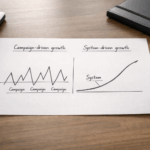
From Campaigns to Systems
Mary Beth Laughton at REI described growth through purpose, membership value, and trust. This was not positioned as marketing. It was described as how the business operates.
Bob Eddy reinforced the same idea, pointing to Dick’s Sporting Goods. Experiential formats and service turn physical retail into a destination, not just a place to transact.
The difference matters. Campaigns end. Systems keep working.
Case Studies: REI, Ulta, Gymshark, and Others
The Icons session offered several variations on this theme. Gymshark’s growth was rooted in owning a specific community and scaling outward from a clear identity. Emma Grede’s Good American focused on serving customers overlooked by traditional sizing models, creating demand by addressing a real gap.
Both examples emphasised discipline. Growth without focus risks breaking the bond with the core audience.
Ulta Beauty provided a clear data-backed view. CEO Kecia Steelman referenced forty-six million active loyalty members and described loyalty as a customer intelligence loop. Data informs personalisation. Personalisation increases frequency. Frequency generates better data.
Even SharkNinja fits this model in its own way. CEO Mark Barrocas outlined a disciplined product innovation process grounded in consumer research and testing. Products move forward only if they meet clear thresholds for quality and appeal. The aim is not volume, but products people want to keep and talk about. As personalisation becomes more automated, trust matters more. Customers still want authenticity, and they notice when experiences feel opaque or overly engineered.
Strategic recommendations for building belonging
- Treat community like a product. REI and Gymshark show that belonging needs cadence, rituals, and intentional design.
- Use loyalty as intelligence. Ulta demonstrates that the real value of loyalty sits in insight and personalisation, not discounts.
- Scale with discipline. Brand dilution weakens belonging. Growth needs to protect the identity that attracted customers in the first place.
Insight 3: Execution as the Competitive Moat
If AI reflects the platform shift and belonging defines the brand, execution is what separates outcomes.
NRF 2026 made this plain: retailers aren’t short on ideas. They’re short on the ability to move from insight to action consistently.
Speed and Decision Velocity
Michael Rubin of Fanatics argued for staying agile as organisations grow. Rubin’s point was that layers of approval slow momentum. Teams that move quickly and iterate tend to outperform those that wait for certainty.
Gary Vaynerchuk applied the same thinking to attention. Platforms now distribute content based on interest, not follower count. This turns marketing into a performance discipline. Speed and relevance matter more than months old fixed campaign plans.
Resilience and focus
Operational resilience came up repeatedly. SharkNinja described supply chain diversification as a response to geopolitical risk. Bob Eddy’s opening remarks made the context clear. Volatility is normal.
JD Sports emphasised a simple operating principle. Do fewer things better. Their transformation work is grounded in focus. Modernisation depends as much on stopping activity as starting it.
Strategic recommendations for execution
- Design for speed. Decision velocity is an advantage. Remove approval layers that do not add value.
- Treat attention as a system. Measure relevance continuously and shift resources as behaviour changes.
- Reduce priorities. Focus creates capacity. Fewer things done well outperform broad activity.
- Assume turbulence. Build resilience into supply chains and operations rather than planning for stability.
Conclusion: The System Builders Win
Leaving NRF 2026, one thing was clear to me. The next wave of retail winners will be system builders.
AI has moved beyond fluff and into the core of commerce. The shift from search to conversation is already underway. Shopify and FairPrice show what happens when intelligence is embedded into transactions and operations.
At the same time, the strongest brands are turning community and loyalty into repeatable systems. REI, Ulta, and others demonstrated how belonging compounds when it is designed intentionally.
Underneath all of it sits execution. Speed. Focus. Resilience. In a volatile environment, these qualities matter more than vision statements.
Many of the operators in New York were less focused on the next trend and more focused on building systems that can hold up when conditions change.
Humaine was proud to be